
Official USCIS Naturalization Interview Guide
What to Expect at Your N-400 Interview
A step-by-step walkthrough of the naturalization interview: what happens, in order, based entirely on official USCIS documentation.
5 Stages · English Test · Civics Test · Oath of Allegiance
At a Glance
Key Facts About the Naturalization Interview
These numbers come directly from official USCIS documentation and the 2025 naturalization test guidelines.

1 Interview
A single in-person appointment at your local USCIS field office
20–40 min
Typical total interview length, including review of your N-400 application
Up to 20
Civics questions asked (2025 test). Officer stops at 12 correct (pass) or when passing is no longer possible
1 of 3
Sentences you must read correctly; also 1 of 3 sentences you must write correctly
Same-Day Possible
The officer may approve your application and schedule an Oath ceremony the same day
Exemptions Exist
50/20 and 55/15 age rules waive the English requirement; disabilities covered by Form N-648
The Interview, Step by Step
5 Stages of the Naturalization Interview
Every USCIS naturalization interview follows the same sequence. Here is what happens in order, based on the USCIS Policy Manual and official interview guidance.
Document Checklist
What to Bring to Your Interview
Based on USCIS Interview Appointment Notice M-477 and the N-400 Instructions. Missing documents can result in your interview being continued.

Do NOT bring original documents that cannot be replaced. Bring certified copies whenever possible. USCIS does not return original documents once submitted.
Everyone Must Bring
Appointment Notice (Form I-797)
The interview appointment notice USCIS mailed you. Without it, you may not be admitted to the building.
Permanent Resident Card (Green Card)
Your current Green Card. You will surrender it at the Oath of Allegiance ceremony when you naturalize.
Government-Issued Photo ID
A state-issued driver's license, state ID, or foreign passport with your photo. Used to verify your identity.
All Passports (valid and expired)
Every passport you have held since becoming a Permanent Resident. The officer uses these to verify your travel history and continuous residence.
Federal Tax Returns or IRS Tax Transcripts (last 5 years)
Certified copies of your Federal tax returns for the past 5 years (or 3 years if applying based on marriage to a U.S. citizen). IRS transcripts (Form 4506-T) are acceptable.
Source: USCIS Appointment Notice M-477; N-400 Instructions
Bring If Applicable
Certified Court Dispositions for Any Arrest
Required for every arrest, citation, or detention, even if charges were dropped, expunged, or you were found not guilty. "Expunged" does not mean you can hide it from USCIS.
Marriage Certificate
Required if you are currently married. Also bring divorce decrees for every prior marriage that ended in divorce.
Legal Name Change Documents
If you have legally changed your name at any point (e.g., through marriage or court order), bring certified documentation.
Military Service Records (Form DD-214)
If you have served in the U.S. Armed Forces, bring your Certificate of Release or Discharge from Active Duty (DD-214).
Proof of Extended Travel Outside the U.S.
If you took any trip outside the U.S. that lasted 6 months or more, bring documentation (airline records, passport stamps). Trips over 1 year may be presumed to have broken continuous residence.
Form N-648 (Medical Certification for Disability Exemption)
If you are requesting an exemption from the English and/or civics test due to a physical or developmental disability or mental impairment, your licensed physician or osteopath must complete Form N-648.
Evidence of U.S. Citizen Spouse (3-Year Applicants)
If you are applying based on 3 years of marriage to a U.S. citizen, bring proof of your spouse's citizenship (U.S. passport, birth certificate, or Certificate of Naturalization) and evidence of your bona fide marriage.
Source: USCIS N-400 Instructions pages 14–22; INA § 316(b)
English Language Test
Speaking, Reading & Writing
The English test has three components. Reading and writing use only words from the official USCIS vocabulary lists below.

Speaking Is Tested Throughout the Entire Interview
There is no separate speaking test. The USCIS officer assesses your English speaking ability by observing how you communicate during the entire interview, answering questions about your N-400, your background, and your eligibility.
Answer in complete sentences when possible.
Instead of just "yes," say "Yes, I have lived in the same address for 3 years." This demonstrates comprehension.
It is acceptable to say "Can you repeat the question?"
If you do not understand a question, politely ask the officer to repeat it or ask more slowly. Do not guess at what is being asked.
You may bring an interpreter only in limited circumstances.
If you qualify for the 50/20 or 55/15 English exemption, you may use an interpreter. You must notify USCIS in advance.
Stay calm. Normal nervousness is expected.
The officer evaluates your overall ability to communicate, not perfect grammar or accent.
Source: USCIS Policy Manual, Vol. 12, Part E, Chapter 2, Section C
Exemptions from the English Test
50/20 Rule
You are 50 years of age or older AND have been a lawful permanent resident for at least 20 years.
INA § 312(b)(1); 8 CFR § 312.1(b)(1)
55/15 Rule
You are 55 years of age or older AND have been a lawful permanent resident for at least 15 years.
INA § 312(b)(2); 8 CFR § 312.1(b)(2)
65/20 Rule (Civics Only)
You are 65 years of age or older AND have been a lawful permanent resident for at least 20 years. You still must take the English test, but study only the 20 asterisked civics questions.
8 CFR § 312.2(c)(2)
Form N-648 (Disability/Impairment)
You have a physical or developmental disability or mental impairment that prevents you from satisfying the English and/or civics requirement. A licensed physician or osteopath must certify this on Form N-648.
INA § 312(b)(3); 8 CFR § 312.3
N-400 Review
What the Officer Actually Asks
The officer goes through your N-400 part by part. These are the key questions you should be prepared to answer, with the exact language from the form, along with why each question matters and what to prepare.

Your Name
The officer confirms the legal name you want printed on your Certificate of Naturalization.
Source: Form N-400, Part 1
Personal & Identifying Information
The officer verifies the foundational identity data on your application against your documents and USCIS records.
Source: Form N-400, Part 2; 8 CFR § 316.4
Biographic Information
The officer confirms your physical description to match you with your identity documents and records.
Source: Form N-400, Part 3
Residence & Employment History
The officer reviews everywhere you have lived and worked since becoming a Permanent Resident.
Source: Form N-400, Parts 4 & 5
Time Outside the United States
Every trip outside the U.S. since becoming a Permanent Resident must be disclosed. Long absences can affect eligibility.
Source: Form N-400, Part 6; INA § 316(b)
Marital History
The officer reviews your current and all prior marriages.
Source: Form N-400, Part 7
Information About Your Children
The officer reviews your children (biological, adopted, and stepchildren) to identify any support obligations or issues that could affect Good Moral Character.
Source: Form N-400, Part 8; INA § 101(f)
Additional Information About You
The officer reviews your immigration history, prior N-400 filings, military service history, and any prior claims to U.S. citizenship.
Source: Form N-400, Part 9; INA §§ 314, 328, 329
Good Moral Character: Background Questions
These are the most sensitive questions on the N-400. They are asked verbatim by the officer. Answer truthfully; false answers are grounds for denial and prosecution.
Source: Form N-400, Part 12 (Good Moral Character); INA § 101(f)
Affiliations with Specific Organizations
The officer will ask specifically about membership in certain types of organizations listed by name on the N-400.
Source: Form N-400, Part 11; INA § 313
Continuous Residence & Physical Presence
The officer verifies that you have met the continuous residence and physical presence requirements for your eligibility category.
Source: Form N-400, Parts 12 & 13; INA §§ 316(a), 319(a)
Good Moral Character
Understanding the Legal Standard
"Good Moral Character" (GMC) is a legal requirement for naturalization defined in the Immigration and Nationality Act (INA). USCIS evaluates your conduct during the statutory period (the 5 years before you file, or 3 years if married to a U.S. citizen), but may look at your entire history.
Arrests must always be disclosed, even if charges were dropped, dismissed, or expunged. Concealing an arrest is itself a ground for denial and may constitute fraud. USCIS conducts criminal background checks on all applicants.
Permanent Absolute Bars
These bars apply regardless of when the conduct occurred. There is no waiver available. (INA § 101(f))
Murder
A conviction for murder at any time in your life is a permanent absolute bar to naturalization, regardless of when it occurred.
INA § 101(f)(8); 8 CFR § 316.10(b)(1)(i)
Aggravated Felony (after Nov. 29, 1990)
A conviction for any aggravated felony committed on or after November 29, 1990 is a permanent absolute bar. Aggravated felonies include drug trafficking, firearms trafficking, sexual abuse of a minor, fraud over $10,000, and many other offenses.
INA § 101(f)(8); INA § 101(a)(43)
Persecution of Others / Genocide
Participation in the persecution, torture, or killing of any person based on race, religion, national origin, or political opinion is a permanent absolute bar.
INA § 101(f)(9)
Conditional Bars (Statutory Period)
These bars apply if the conduct occurred during the statutory period (5 or 3 years before filing). (INA § 101(f)(1)–(8))
Habitual Drunkard
Being a habitual drunkard during the statutory period (5 or 3 years before filing) bars a finding of Good Moral Character.
INA § 101(f)(1)
Illegal Gambling
Earning principal income from illegal gambling, or being convicted of two or more gambling offenses, during the statutory period.
INA § 101(f)(5)
Failure to Pay Court-Ordered Child Support or Alimony
Willfully failing to support your dependents as ordered by a court during the statutory period.
INA § 101(f)(6)
Confinement to a Penal Institution (180+ days)
Being confined to a penal institution for a total of 180 days or more during the statutory period (not including political detention).
INA § 101(f)(7)
Two or More DUI Convictions
Two or more convictions for driving under the influence of alcohol or drugs during the statutory period may bar a finding of Good Moral Character.
USCIS Policy Manual, Vol. 12, Part F, Chapter 5
Unlawful Acts Not Listed Above
USCIS officers have broad discretion to find that an applicant lacks Good Moral Character based on any unlawful act, even if not explicitly listed in the statute, if it reflects adversely on the applicant's moral character.
INA § 101(f) (catch-all provision); USCIS Policy Manual, Vol. 12, Part F
Consult an immigration attorney if you have any criminal history, including minor offenses, arrests without conviction, expunged records, or DUIs. This website does not provide legal advice.
Sources: INA § 101(f); USCIS Policy Manual, Vol. 12, Part F
After the Interview
Three Possible Outcomes
At the end of your interview, the officer will issue one of three decisions. Here is what each outcome means and what happens next.
Approved
Your application is granted at the interview.
- You receive Form N-652, Naturalization Interview Results, indicating approval.
- An Oath of Allegiance ceremony is scheduled. This may happen the same day at some offices (administrative oath) or at a separate date.
- At the Oath ceremony, you surrender your Permanent Resident Card (Green Card).
- After taking the Oath, you receive Form N-550, Certificate of Naturalization.
- You are now a United States citizen.
Continued
The officer needs more time or documents before deciding.
- The officer needs additional time, information, or supporting documents.
- You receive Form N-14, which lists exactly what is required.
- You typically have 87 days to respond with the requested materials.
- A continued case does NOT mean your application is denied. It is very common.
- If you fail to respond within the deadline, USCIS may issue a decision without the additional evidence.
Denied
You receive written notice with the specific grounds for denial.
- You receive a written notice of denial with specific reasons.
- You have 30 days from the date of the denial to request a hearing before an immigration officer.
- To request a hearing, file Form N-336 (Request for Hearing on a Decision in Naturalization Proceedings) with the $700 fee.
- If the N-336 hearing also results in denial, you may petition a federal district court.
- Consult an immigration attorney immediately if your application is denied.
Source: INA § 336; 8 CFR § 336.2
The Oath of Allegiance
The Words That Make You a Citizen
You will recite this oath aloud at your Oath of Allegiance ceremony. It is the final step of the naturalization process. The full text, verbatim, is below.
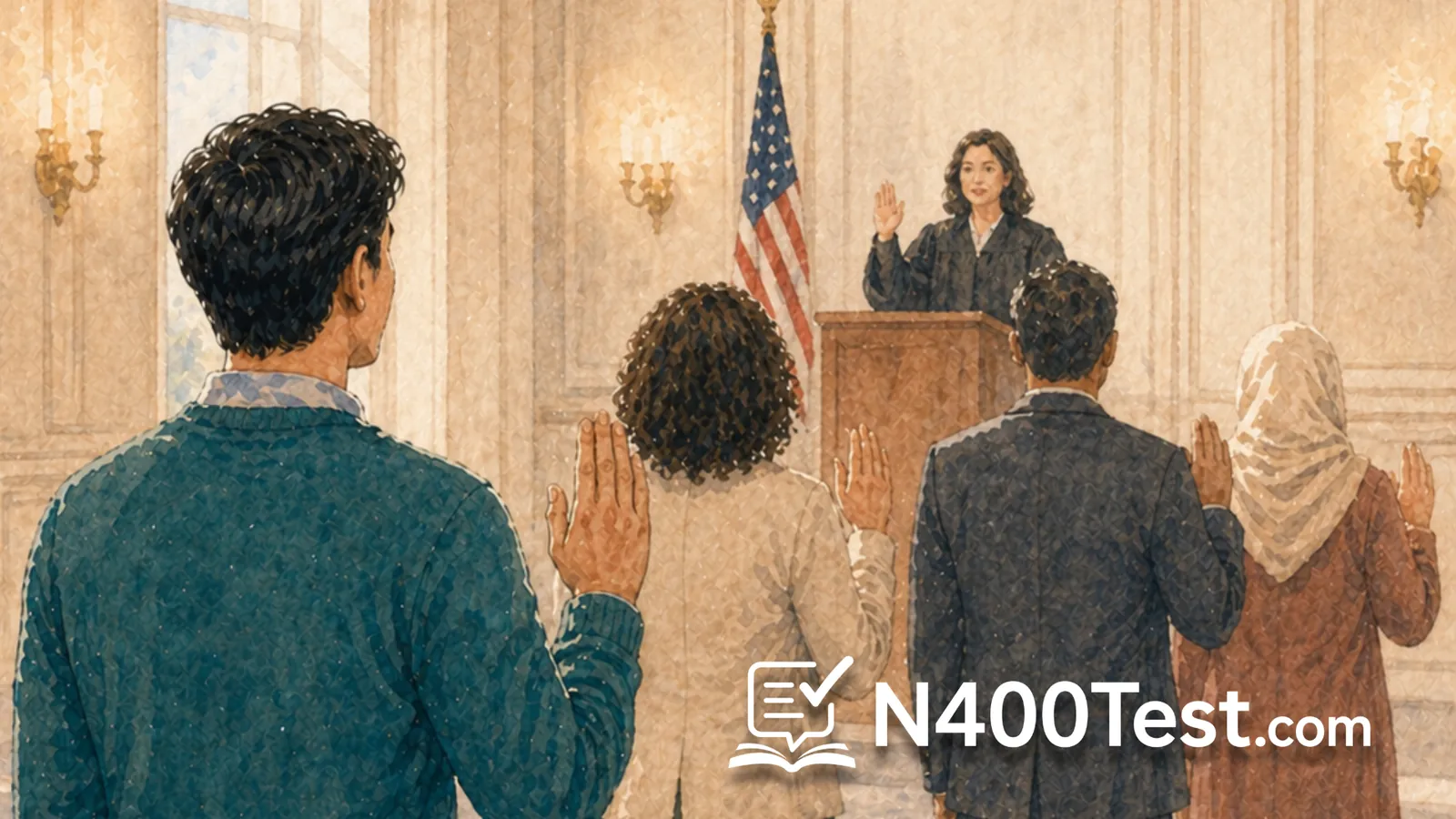
“I hereby declare, on oath, that I absolutely and entirely renounce and abjure all allegiance and fidelity to any foreign prince, potentate, state, or sovereignty, of whom or which I have heretofore been a subject or citizen; that I will support and defend the Constitution and laws of the United States of America against all enemies, foreign and domestic; that I will bear true faith and allegiance to the same; that I will bear arms on behalf of the United States when required by the law; that I will perform noncombatant service in the Armed Forces of the United States when required by the law; that I will perform work of national importance under civilian direction when required by the law; and that I take this obligation freely, without any mental reservation or purpose of evasion; so help me God.”
Religious Accommodation
Members of certain religious groups whose beliefs prohibit bearing arms may omit the clauses about bearing arms and performing noncombatant service. The phrase “so help me God” may also be omitted by any applicant who prefers to affirm rather than swear. These accommodations are granted under INA § 337(a).
Source: INA § 337; USCIS Policy Manual, Vol. 12, Part J, Chapter 3. Public domain government text
Deep Dives
Go Further
Each topic from the interview gets its own full guide with sourced details, vocabulary lists, and step-by-step breakdowns.
Mock Interview Simulator
Practice the entire interview — the oath, the N-400 review, and the civics, reading, and writing tests — start to finish. Free, private, no typing.
Read guideThe Naturalization Process
All 10 steps from checking eligibility to receiving your Certificate of Naturalization.
Read guideEnglish Test Overview
Speaking, reading, and writing requirements with the full official vocabulary lists and exemption rules.
Read guideOath of Allegiance
The full Oath text, a clause-by-clause breakdown of what it means, accommodations, and ceremony details.
Read guideReady to practice the civics test?
Study All 128 Civics Questions
The civics test is asked verbally during your interview. Study every question and reveal the answer when you're ready, completely free.
Study Civics QuestionsStay Sharp
Study Tips & Updates in Your Inbox
Join thousands preparing for their citizenship interview. Get weekly civics tips, practice questions, and new study tools - straight to your inbox.
Free. No spam. Unsubscribe anytime.