
The Final Step
Oath of Allegiance
The words you will recite to become a United States citizen - the full text, what each clause means, and what to expect at the ceremony.
The Full Text
The Oath of Allegiance, Verbatim
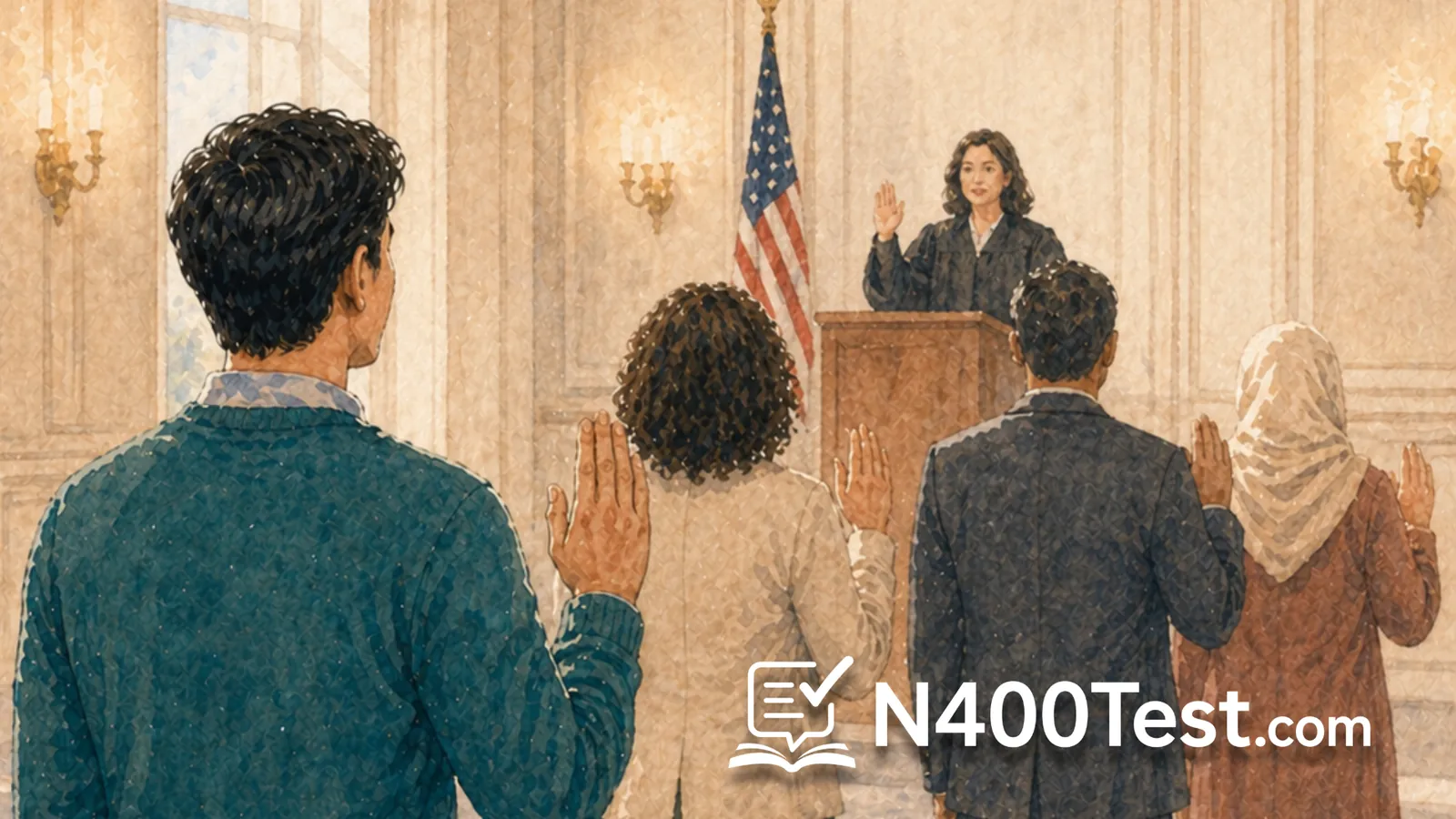
You will recite this oath aloud at your ceremony. This is the complete, unmodified text as prescribed by federal law.
“I hereby declare, on oath, that I absolutely and entirely renounce and abjure all allegiance and fidelity to any foreign prince, potentate, state, or sovereignty, of whom or which I have heretofore been a subject or citizen; that I will support and defend the Constitution and laws of the United States of America against all enemies, foreign and domestic; that I will bear true faith and allegiance to the same; that I will bear arms on behalf of the United States when required by the law; that I will perform noncombatant service in the Armed Forces of the United States when required by the law; that I will perform work of national importance under civilian direction when required by the law; and that I take this obligation freely, without any mental reservation or purpose of evasion; so help me God.”
Source: INA § 337; USCIS Policy Manual, Vol. 12, Part J, Chapter 3. Public domain government text.
Clause by Clause
What It Means
Each clause of the Oath carries a specific legal meaning. Here is a plain-English breakdown of what you are committing to when you say these words.
“I hereby declare, on oath, that I absolutely and entirely renounce and abjure all allegiance and fidelity to any foreign prince, potentate, state, or sovereignty, of whom or which I have heretofore been a subject or citizen;”
You are formally ending any legal or political loyalty you hold to any other country or government. This is not about giving up your culture or heritage - it is a legal declaration that the U.S. is your only sovereign.
“that I will support and defend the Constitution and laws of the United States of America against all enemies, foreign and domestic;”
You commit to upholding the legal framework of the United States - the Constitution and the laws made under it - against any threat from outside or inside the country.
“that I will bear true faith and allegiance to the same;”
You pledge genuine loyalty to the Constitution and laws, not just on paper. This reinforces the prior clause: your commitment is sincere.
“that I will bear arms on behalf of the United States when required by the law;”
If required by law - for example, through a military draft - you agree to serve in the armed forces of the United States. Members of certain religious groups may omit this clause.
“that I will perform noncombatant service in the Armed Forces of the United States when required by the law;”
If you cannot bear arms for religious reasons, you still agree to serve in a non-combat role (e.g., medical corps) if required by law. This clause may also be omitted by eligible religious objectors.
“that I will perform work of national importance under civilian direction when required by the law;”
If called upon during a national emergency, you agree to perform civilian work deemed essential to the national interest - for example, directed by a civilian government agency.
“and that I take this obligation freely, without any mental reservation or purpose of evasion; so help me God.”
You confirm that you are making this pledge voluntarily, with full intent, and without any hidden plans to avoid your obligations. The phrase "so help me God" may be omitted by any applicant who prefers to affirm rather than swear.
Accommodations
Religious & Conscientious Accommodations
Federal law explicitly allows two modifications to the Oath for applicants with qualifying beliefs.
Arms-Bearing Exemption
INA § 337(a)Members of a recognized religious organization whose beliefs prohibit bearing arms may omit the clauses about bearing arms and performing noncombatant service. You must attach a statement explaining your religious beliefs when you file Form N-400.
Omitting “so help me God”
INA § 337(a); USCIS Policy Manual, Vol. 12, Part J, Chapter 3Any applicant may choose to affirm rather than swear the Oath. The phrase "so help me God" may be omitted without any religious documentation - simply inform the USCIS officer at the ceremony.
The Ceremony
What to Expect
The Oath ceremony is the final step of the naturalization process. After you take the Oath, you are legally a United States citizen.
- Ceremonies are typically scheduled within a few weeks of your interview approval, though same-day administrative oaths are possible at some offices.
- Immediate family members are welcome to attend most ceremonies as guests.
- You will surrender your Permanent Resident Card (Green Card) at the ceremony.
- Immediately after taking the Oath, you will receive Form N-550, Certificate of Naturalization - your proof of citizenship.
- After the ceremony you can apply for a U.S. passport and register to vote.
Source: USCIS Policy Manual, Vol. 12, Part J, Chapter 4

You're almost there.
Make Sure You're Ready for the Interview
The civics test is asked verbally during your interview. Study every question and practice until you're confident.
Stay Sharp
Study Tips & Updates in Your Inbox
Join thousands preparing for their citizenship interview. Get weekly civics tips, practice questions, and new study tools - straight to your inbox.
Free. No spam. Unsubscribe anytime.